«Listen simply to
"LA" Anfuso as one does in the face of a GREAT REVELATION», wrote
the major French critic Xauier Lacavalerie on Nella Anfuso.
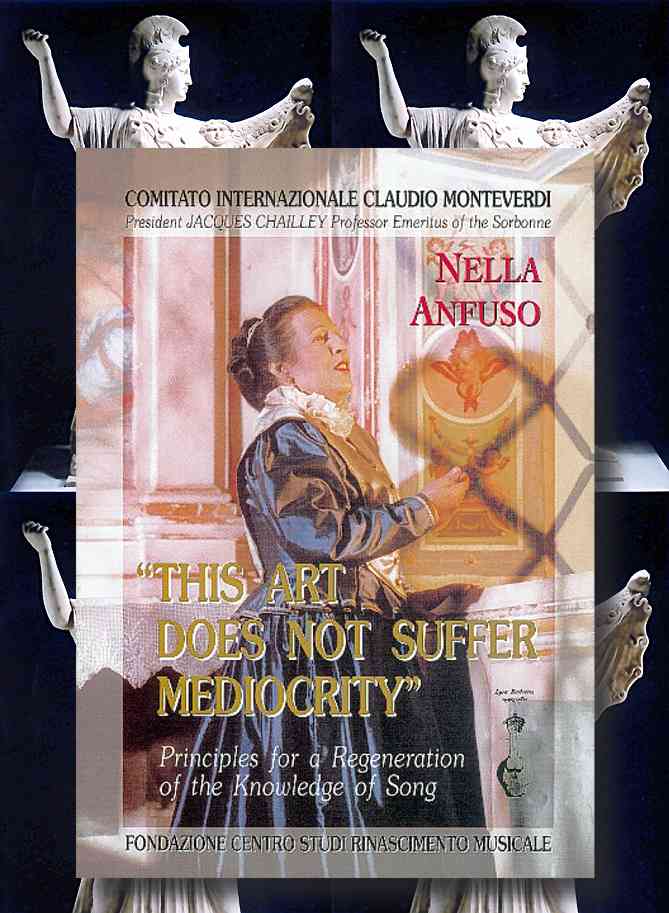
In this book the "Dernière héritière de
l'Ancienne Ecole Italienne" (Jacques Chailley), documents totally
and completely the aesthetic and technical features of Italian vocal
style during the golden centuries from the Renaissance up until the
beginning of the Romantic period.
At a time when there is vocal
deafness, in which the industry, increasingly uncultivated, offers
us on the one hand operatic shouters from the 19th century and
the "mewings" of pre-19th century music on the other, it is
refreshing to be able to go back to the source and retrieve the
Canto in its deepest and highest meaning, the "expressive modulation
of the human voice".
In the present state of
decadence of an entire civilisation we want to remember in this
volume the great art of the golden age of song from the 16th century
to the beginning of the 19th.
Among all the arts the
vocal art is the most fragile even though it is the most intense,
and reflects, perhaps like no other, the very essence of a
civilisation.
In this second half of the
20th century, in which Poetry is practically dead, what can happen
to Song, which is so intimately connected to it? If to this we add
the "vile interest" of which already at the end of the 18th century
Giambattista Mancini
spoke and the crass ignorance that also distorts the importance the
importance of roles in today's operatic performances (directors,
conductors, singers the latter simple puppets -in terms of their
interpretation - in the hands of the first two) we get a complete
picture of the present situation.
But the most serious fact
is the total loss of awareness of that which is and has been Song, a
loss that her caused use and abuse of a terminology in total
contrast with the real and original meaning of it.
This general lack of
understanding of good
vocalism becomes a tragic phenomenon in the "fashion" for
rediscovery of the pre-19th century repertoire. Through an irony of
Destiny we participate in the appropriation of a Vocal Art which
represents the "summa"
of vocalism by real and proper impotent deceivers.
It is therefore time to
really get to know what was the great Italian School of Song.
This publication is aimed
at all those who, with honest intent and pure heart, desire to get
to know a really complex art, and enjoy its immense treasures.